Wednesday, October 6, 2010
Saturday, April 17, 2010


Friday, April 16, 2010
Recipe : White Radish cake (loh pak kou)
This is the second time I made white radish cake and I can safely tell you that it is the easiest to make because you can never go wrong with it. It is very nice, tasty, cheap and yummy. In fact, much yummier than any of the dimsum restaurant version.
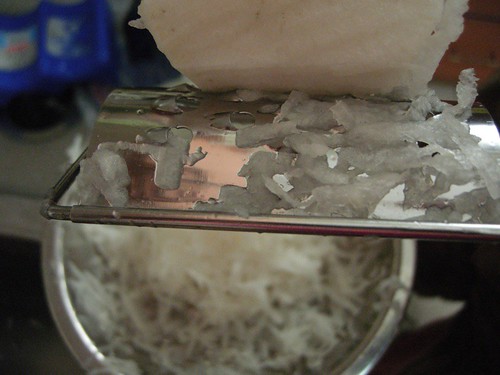
The white radish must be grated coarsely. Then, cook with some water. Initially, the smell of the fresh white radish can be off putting because my son said ‘Blek, this smells like some chemical.’ White radish has very strong ‘earthy’ smell so you need to cook it in some water for about 15-20 minutes. The grated white radish will soften and when cooked for a while, the smell disappears.
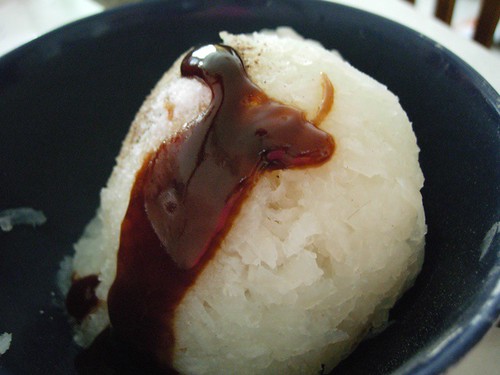
Then, I squeezed out the water from the cooked radish and season with oyster sauce, pepper and salt.

In another pan, I fried some dried shrimps and pound them.
Then, in another huge bowl, I mixed a batter of flour and boiling hot water. After the mixture is well mixed, I added the dried shrimps and the white radish and combine with the flour batter.
Next, put the batter into thin layer in a steaming pan and spread the surface smooth and steam over boiling water for about 30-45 minutes, depending on the thickness of your batter.
The steamed white radish cake can be eaten on its own. However, many people prefer the fried version. I cut the radish cakes into oblong and deep fried them in very hot oil till the outer layer is crispy and brown.
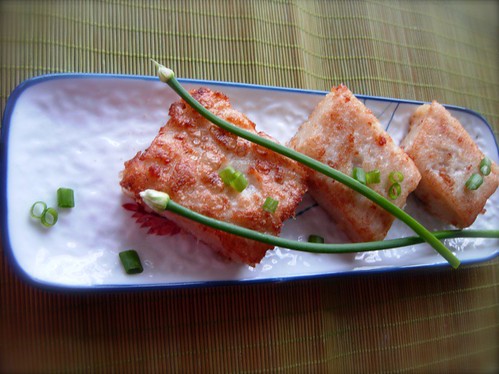
Recipe for white radish cake
Part A –
500 – 600 grams of white radish, skinned and grated.
100 ml water
Cook the grated radish with water for about 15-20 minutes until the radish is soft and you don’t smell a very strong earthy smell.
Part B -
One handful of dried shrimps, either roasted or fried in oil till crispy. Pound
Optional – 1 Chinese sausage, cut into tiny cubes.
Part C –
300 grams rice flour (do not use glutinous rice flour but only rice flour)
60 grams wheat starch or tung mee fun (tang mien fern) – wheat starch is wheat flour without gluten. The gluten is normally used to make vegetarian mock meats while the leftover flour is the wheat starch. It gives a sticky, jelly like texture like tapioca flour. Normally it is use for making chai kuey which is an almost transparent like skin. Can be found at some supermarkets and cake supplies shop.
600-700 mls hot, BOILING, water.
Mix the flour in a big mixing bowl, make a well in the centre and pour the hot boiling water into it. Mix with spatula till well combine.
PART D
Seasonings consist of 1 teaspoon salt, dash of pepper and 1 teaspoon of oyster sauce (optional)
______________________
When the flour batter is well mixed, add the radish, dried shrimps and seasonings and combine well.
Put into steaming tray and steam for 30-45 minutes. Ideally, keep the thickness to about half an inch.
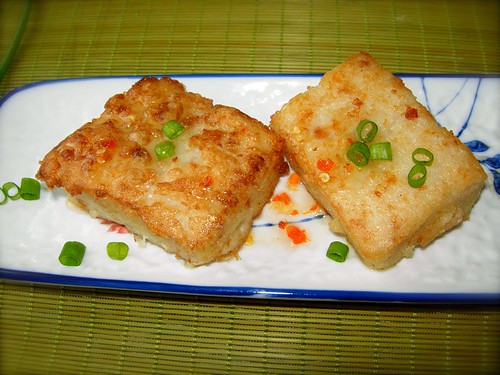
You can either deep fried the white radish cake or you can even cut the steamed radish cakes into cubes and fry them with beansprouts, eggs, garlic and prawns just like frying koay kark or koay teow style.
I got this recipe from a Chinese/English recipe book and they mentioned that white radish cake is a Chinese New Year festival dish. I halved the portion of the ingredients given because my original recipe calls for 1 kilogram of white radish! You can actually make a big portion, steamed it and store it nicely in the fridge, wrapped. Then, take the portion required and deep fry before serving.
Wednesday, April 14, 2010
Inche Kabin | Nyonya Fried Chicken recipe

1kg chicken (cut into pieces)
Oil for deep frying
Seasoning:
2½ tbsp curry powder
1 tsp salt
10 tbsp coconut milk
You’ll need to marinate the chicken in advance, at least 4 hours. In a frying pan, deep fry the seasoned chicken until ¾ cooked and cool.
Frying method:
Heat the oil till very hot and deep fry for approximately 1 minute or when sizzling subsides. Remove the chicken. Allow the oil the heat up again and repeat process, twice till very crisp and golden brown.
Yam Cake recipe

Ingredients:
250 grams rice flour
125 grams wheat flour (Tung Meen Fun)
2 ½ cups water (heat till quite warm)
250 grams yam (steam till cooked)
120 grams dried prawns (pound and fried till brown)
50 grams of fried shallots
Fresh spring onion, cut freshly chilli
Method:
Mix the rice flour, wheat flour and add in the warm water and add in ¾ tablespoon of salt, 1 tablespoon of rock sugar, 1 table spoon of vegetable oil or garlic oil , 1 teaspoon of white pepper, 1 teaspoon of 5 spice. Add in the steamed yam and mix all the ingredients thoroughly. Oil a stainless steel plate (22″ in diameter) before adding the mixture and steam for 45 minutes in high heat, add more water after 20 minutes.
Cool the yam cake before garnishing with fried dried prawns, fried shallots, fresh spring onion and freshly cut chilli.
Oxyhydrogen
Oxyhydrogen is a mixture of hydrogen (H2) and oxygen (O2) gases, typically in a 2:1 molar ratio, the same proportion as water.[1] This gaseous mixture is used for torches for the processing of refractory materials and was the first[citation needed] gaseous mixture used for welding. In practice a ratio of 4:1 or 5:1 hydrogen:oxygen is required to avoid an oxidizing flame.[2]
Properties
Oxyhydrogen will combust when brought to its autoignition temperature. For a stoichiometric mixture at normal atmospheric pressure, autoignition occurs at about 570 °C (1065 °F).[3] The minimum energy required to ignite such a mixture with a spark is about 20 microjoules.[3] At normal temperature and pressure, oxyhydrogen can burn when it is between about 4% and 95% hydrogen by volume.[3]
When ignited, the gas mixture converts to water vapor and releases energy, which sustains the reaction: 241.8 kJ of energy (LHV) for every mole of H2 burned. The amount of heat energy released is independent of the mode of combustion, but the temperature of the flame varies.[1] The maximum temperature of about 2800 °C is achieved with a pure stoichiometric mixture, about 700 degrees hotter than a hydrogen flame in air.[4][5][6] When either of the gases are mixed in excess of this ratio, or when mixed with an inert gas like nitrogen, the heat must spread throughout a greater quantity of matter and the temperature will be lower.[1]
Production
A pure stoichiometric mixture may be obtained by water electrolysis, which uses an electric current to dissociate the water molecules:- electrolysis: 2 H2O → 2 H2 + O2
- combustion: 2 H2 + O2 → 2 H2O
Lighting
Many forms of oxyhydrogen lamps have been described, such as the limelight, which used an oxyhydrogen flame to heat a piece of lime to white hot incandescence.[7] Because of the explosiveness of the oxyhydrogen, limelights have been replaced by electric lighting.
Oxyhydrogen was once used in working platinum because at the time such a torch was the only device that could attain the temperature required to melt the metal (1768.3 °C).[1] These techniques have been superseded by the electric arc furnace.
[edit] Oxyhydrogen blowpipe

The oxy-hydrogen blowpipe was developed by English mineralogist Edward Daniel Clarke and American chemist Robert Hare in the early nineteenth century. It produced a flame hot enough to melt such refractory materials as platinum, porcelain, and fire brick, and was a valuable tool in several fields of science.[8]
[edit] Oxyhydrogen torch
An oxyhydrogen torch is an oxy-gas torch, which burns hydrogen (the fuel) with oxygen (the oxidizer). It is used for cutting and welding metals, glass, and thermoplastics.[7] An oxyhydrogen torch is used in the glass industry for "fire polishing"; slightly melting the surface of glass to remove scratches and dullness.[citation needed]
Due to competition from the acetylene-fueled cutting torch and from arc welding, the oxyhydrogen torch is seldom used today, but it remains the preferred cutting tool in some niche applications -- see oxy-fuel welding and cutting.
[edit] Water torch
A "water torch" is a portable oxyhydrogen torch that combines a DC power supply and an electrolytic cell with a pressure gauge and flashback arrestor. Water is decomposed on-demand into oxyhydrogen, obviating the need for separate hydrogen and oxygen tanks. The original was designed in 1962 by William Rhodes and Raymond Henes of the Henes Manufacturing Co.[9] (now Arizona Hydrogen Manufacturing, Inc.) and marketed under the trade mark "Water Welder". A hypodermic needle was originally used for the torch tip.
[edit] Fringe science and fraud
Oxyhydrogen is often mentioned in conjunction with devices that claim to operate a vehicle using water as a fuel, or that burn the gas in torches for welding and cutting at outlandish temperatures, sometimes under the name "Brown's Gas" after fraudster Yull Brown who advocated such devices, or "HHO gas" after the claims of fringe physicist Ruggero Santilli.
The most common and decisive counter-argument against using the gas as a fuel is that the energy required to split water molecules exceeds the energy recouped by burning it, and these devices reduce, rather than improve fuel efficiency.[10]
Subscribe to:
Posts (Atom)


