Wednesday, October 6, 2010
Saturday, April 17, 2010


Friday, April 16, 2010
Recipe : White Radish cake (loh pak kou)
This is the second time I made white radish cake and I can safely tell you that it is the easiest to make because you can never go wrong with it. It is very nice, tasty, cheap and yummy. In fact, much yummier than any of the dimsum restaurant version.
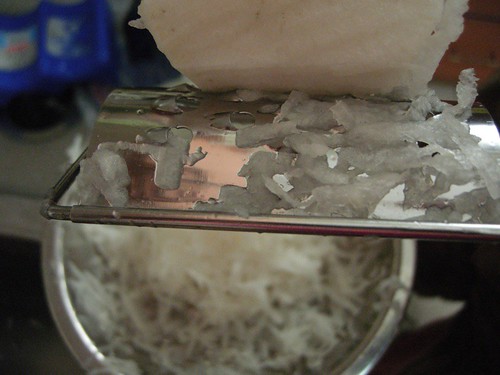
The white radish must be grated coarsely. Then, cook with some water. Initially, the smell of the fresh white radish can be off putting because my son said ‘Blek, this smells like some chemical.’ White radish has very strong ‘earthy’ smell so you need to cook it in some water for about 15-20 minutes. The grated white radish will soften and when cooked for a while, the smell disappears.
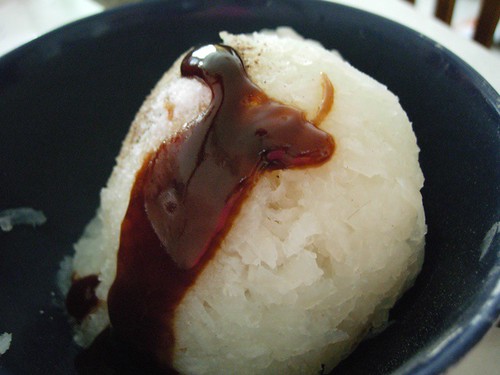
Then, I squeezed out the water from the cooked radish and season with oyster sauce, pepper and salt.

In another pan, I fried some dried shrimps and pound them.
Then, in another huge bowl, I mixed a batter of flour and boiling hot water. After the mixture is well mixed, I added the dried shrimps and the white radish and combine with the flour batter.
Next, put the batter into thin layer in a steaming pan and spread the surface smooth and steam over boiling water for about 30-45 minutes, depending on the thickness of your batter.
The steamed white radish cake can be eaten on its own. However, many people prefer the fried version. I cut the radish cakes into oblong and deep fried them in very hot oil till the outer layer is crispy and brown.
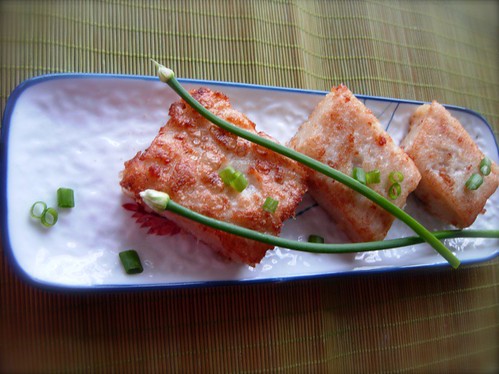
Recipe for white radish cake
Part A –
500 – 600 grams of white radish, skinned and grated.
100 ml water
Cook the grated radish with water for about 15-20 minutes until the radish is soft and you don’t smell a very strong earthy smell.
Part B -
One handful of dried shrimps, either roasted or fried in oil till crispy. Pound
Optional – 1 Chinese sausage, cut into tiny cubes.
Part C –
300 grams rice flour (do not use glutinous rice flour but only rice flour)
60 grams wheat starch or tung mee fun (tang mien fern) – wheat starch is wheat flour without gluten. The gluten is normally used to make vegetarian mock meats while the leftover flour is the wheat starch. It gives a sticky, jelly like texture like tapioca flour. Normally it is use for making chai kuey which is an almost transparent like skin. Can be found at some supermarkets and cake supplies shop.
600-700 mls hot, BOILING, water.
Mix the flour in a big mixing bowl, make a well in the centre and pour the hot boiling water into it. Mix with spatula till well combine.
PART D
Seasonings consist of 1 teaspoon salt, dash of pepper and 1 teaspoon of oyster sauce (optional)
______________________
When the flour batter is well mixed, add the radish, dried shrimps and seasonings and combine well.
Put into steaming tray and steam for 30-45 minutes. Ideally, keep the thickness to about half an inch.
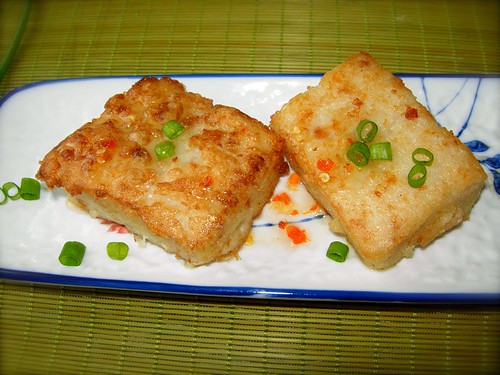
You can either deep fried the white radish cake or you can even cut the steamed radish cakes into cubes and fry them with beansprouts, eggs, garlic and prawns just like frying koay kark or koay teow style.
I got this recipe from a Chinese/English recipe book and they mentioned that white radish cake is a Chinese New Year festival dish. I halved the portion of the ingredients given because my original recipe calls for 1 kilogram of white radish! You can actually make a big portion, steamed it and store it nicely in the fridge, wrapped. Then, take the portion required and deep fry before serving.
Wednesday, April 14, 2010
Inche Kabin | Nyonya Fried Chicken recipe

1kg chicken (cut into pieces)
Oil for deep frying
Seasoning:
2½ tbsp curry powder
1 tsp salt
10 tbsp coconut milk
You’ll need to marinate the chicken in advance, at least 4 hours. In a frying pan, deep fry the seasoned chicken until ¾ cooked and cool.
Frying method:
Heat the oil till very hot and deep fry for approximately 1 minute or when sizzling subsides. Remove the chicken. Allow the oil the heat up again and repeat process, twice till very crisp and golden brown.
Yam Cake recipe

Ingredients:
250 grams rice flour
125 grams wheat flour (Tung Meen Fun)
2 ½ cups water (heat till quite warm)
250 grams yam (steam till cooked)
120 grams dried prawns (pound and fried till brown)
50 grams of fried shallots
Fresh spring onion, cut freshly chilli
Method:
Mix the rice flour, wheat flour and add in the warm water and add in ¾ tablespoon of salt, 1 tablespoon of rock sugar, 1 table spoon of vegetable oil or garlic oil , 1 teaspoon of white pepper, 1 teaspoon of 5 spice. Add in the steamed yam and mix all the ingredients thoroughly. Oil a stainless steel plate (22″ in diameter) before adding the mixture and steam for 45 minutes in high heat, add more water after 20 minutes.
Cool the yam cake before garnishing with fried dried prawns, fried shallots, fresh spring onion and freshly cut chilli.
Oxyhydrogen
Oxyhydrogen is a mixture of hydrogen (H2) and oxygen (O2) gases, typically in a 2:1 molar ratio, the same proportion as water.[1] This gaseous mixture is used for torches for the processing of refractory materials and was the first[citation needed] gaseous mixture used for welding. In practice a ratio of 4:1 or 5:1 hydrogen:oxygen is required to avoid an oxidizing flame.[2]
Properties
Oxyhydrogen will combust when brought to its autoignition temperature. For a stoichiometric mixture at normal atmospheric pressure, autoignition occurs at about 570 °C (1065 °F).[3] The minimum energy required to ignite such a mixture with a spark is about 20 microjoules.[3] At normal temperature and pressure, oxyhydrogen can burn when it is between about 4% and 95% hydrogen by volume.[3]
When ignited, the gas mixture converts to water vapor and releases energy, which sustains the reaction: 241.8 kJ of energy (LHV) for every mole of H2 burned. The amount of heat energy released is independent of the mode of combustion, but the temperature of the flame varies.[1] The maximum temperature of about 2800 °C is achieved with a pure stoichiometric mixture, about 700 degrees hotter than a hydrogen flame in air.[4][5][6] When either of the gases are mixed in excess of this ratio, or when mixed with an inert gas like nitrogen, the heat must spread throughout a greater quantity of matter and the temperature will be lower.[1]
Production
A pure stoichiometric mixture may be obtained by water electrolysis, which uses an electric current to dissociate the water molecules:- electrolysis: 2 H2O → 2 H2 + O2
- combustion: 2 H2 + O2 → 2 H2O
Lighting
Many forms of oxyhydrogen lamps have been described, such as the limelight, which used an oxyhydrogen flame to heat a piece of lime to white hot incandescence.[7] Because of the explosiveness of the oxyhydrogen, limelights have been replaced by electric lighting.
Oxyhydrogen was once used in working platinum because at the time such a torch was the only device that could attain the temperature required to melt the metal (1768.3 °C).[1] These techniques have been superseded by the electric arc furnace.
[edit] Oxyhydrogen blowpipe

The oxy-hydrogen blowpipe was developed by English mineralogist Edward Daniel Clarke and American chemist Robert Hare in the early nineteenth century. It produced a flame hot enough to melt such refractory materials as platinum, porcelain, and fire brick, and was a valuable tool in several fields of science.[8]
[edit] Oxyhydrogen torch
An oxyhydrogen torch is an oxy-gas torch, which burns hydrogen (the fuel) with oxygen (the oxidizer). It is used for cutting and welding metals, glass, and thermoplastics.[7] An oxyhydrogen torch is used in the glass industry for "fire polishing"; slightly melting the surface of glass to remove scratches and dullness.[citation needed]
Due to competition from the acetylene-fueled cutting torch and from arc welding, the oxyhydrogen torch is seldom used today, but it remains the preferred cutting tool in some niche applications -- see oxy-fuel welding and cutting.
[edit] Water torch
A "water torch" is a portable oxyhydrogen torch that combines a DC power supply and an electrolytic cell with a pressure gauge and flashback arrestor. Water is decomposed on-demand into oxyhydrogen, obviating the need for separate hydrogen and oxygen tanks. The original was designed in 1962 by William Rhodes and Raymond Henes of the Henes Manufacturing Co.[9] (now Arizona Hydrogen Manufacturing, Inc.) and marketed under the trade mark "Water Welder". A hypodermic needle was originally used for the torch tip.
[edit] Fringe science and fraud
Oxyhydrogen is often mentioned in conjunction with devices that claim to operate a vehicle using water as a fuel, or that burn the gas in torches for welding and cutting at outlandish temperatures, sometimes under the name "Brown's Gas" after fraudster Yull Brown who advocated such devices, or "HHO gas" after the claims of fringe physicist Ruggero Santilli.
The most common and decisive counter-argument against using the gas as a fuel is that the energy required to split water molecules exceeds the energy recouped by burning it, and these devices reduce, rather than improve fuel efficiency.[10]

Amateur radio (HAM) Band plans and frequency allocations
The International Telecommunication Union (ITU) governs the allocation of communications frequencies worldwide, with participation by each nation's communications regulation authority. National communications regulators have some liberty to restrict access to these frequencies or to award additional allocations as long as radio services in other countries do not suffer interference. In some countries, specific emission types are restricted to certain parts of the radio spectrum, and in most other countries, International Amateur Radio Union (IARU) member societies adopt voluntary plans to ensure the most effective use of spectrum.
In a few cases, a national telecommunication agency may also allow hams to use frequencies outside of the internationally allocated amateur radio bands. In Trinidad and Tobago, hams are allowed to use a repeater which is located on 148.800 MHz. This repeater is used and maintained by the National Emergency Management Agency (NEMA), but may be used by radio amateurs in times of emergency or during normal times to test their capability and conduct emergency drills. This repeater can also be used by non-ham NEMA staff and REACT members. In Australia and New Zealand ham operators are authorized to use one of the UHF TV channels. In the U.S., in cases of emergency, amateur radio operators providing essential communication needs in connection with the immediate safety of human life and immediate protection of property when normal communication systems are not available may use any frequency including those of other radio services such as police and fire communications and the Alaska statewide emergency frequency of 5167.5 kHz.
Similarly, amateurs in the United States may apply to be registered with the Military Affiliate Radio System (MARS). Once approved and trained, these amateurs also operate on US government military frequencies to provide contingency communications and morale message traffic support to the military services.
Amateur radio (HAM) Privileges
Unlike other RF spectrum users, radio amateurs may build or modify transmitting equipment for their own use within the amateur spectrum without the need to obtain government certification of the equipment.[24][25] Licensed amateurs can also use any frequency in their bands (rather than being allocated fixed frequencies or channels) and can operate medium to high-powered equipment on a wide range of frequencies[26] so long as they meet certain technical parameters including occupied bandwidth, power, and maintenance of spurious emission.
As noted, radio amateurs have access to frequency allocations throughout the RF spectrum, enabling choice of frequency to enable effective communication whether across a city, a region, a country, a continent or the whole world regardless of season or time day or night. The shortwave bands, or HF, can allow worldwide communication, the VHF and UHF bands offer excellent regional communication, and the broad microwave bands have enough space, or bandwidth, for television (known as SSTV and FSTV) transmissions and high-speed data networks.

Although allowable power levels are moderate by commercial standards, they are sufficient to enable global communication. Power limits vary from country to country and between license classes within a country. For example, the power limits for the highest available license classes in a few selected countries are: 2.25 kW in Canada, was 2 kW in the former Yugoslavia, 1.5 kW in the United States, 1 kW in Belgium and Switzerland, 750 W in Germany, 500 W in Italy, 400 W in Australia, India and the United Kingdom, and 150 W in Oman. Lower license classes usually have lower power limits; for example, the lowest license class in the UK has a limit of just 10 W. Amateur radio operators are encouraged both by regulations and tradition of respectful use of the spectrum to use as little power as possible to accomplish the communication.[27]
When traveling abroad, visiting amateur operators must follow the rules of the country in which they wish to operate. Some countries have reciprocal international operating agreements allowing hams from other countries to operate within their borders with just their home country license. Other host countries require that the visiting ham apply for a formal permit, or even a new host country-issued license, in advance.
Many jurisdictions issue specialty vehicle registration plates to amateur radio operators who provide proof of an amateur radio license.[28][29] The fees for application and renewal are usually less than standard plates.[28][30]
Amateur radio (HAM) Call signs
Upon licensing, a radio amateur's national government issues a unique call sign to the radio amateur. The holder of a call sign uses it on the air to legally identify the operator or station during any and all radio communication.[22] In certain jurisdictions, an operator may also select a "vanity" call sign although these must also conform to the issuing government's allocation and structure used for Amateur Radio call signs.[23] Some jurisdictions, such as the U.S., require that a fee be paid to obtain such a vanity call sign; in others, such as the UK, a fee is not required and the vanity call sign may be selected when the license is applied for.
Call sign structure as prescribed by the ITU, consists of three parts which break down as follows, using the call sign ZS1NAT as an example:
- ZS – Shows the country from which the call sign originates and may also indicate the license class. (This call sign is licensed in South Africa, and is CEPT Class 1).
- 1 – Gives the subdivision of the country or territory indicated in the first part (this one refers to the Western Cape).
- NAT – The final part is unique to the holder of the license, identifying that person specifically.
Many countries do not follow the ITU convention for the numeral. In the United Kingdom the calls G2xxx, G3xxx, and G6xxx may be issued to stations, these are Full License Holders. Additional licenses are granted in respect of Foundation Licensees M3xxx and M6xxx, Intermediate Licensees 2E1xxx and 2E0xxx and Full License Holders M0xxx and M1xxx. In the United States, the numeral indicates the geographical district the holder resided in when the license was issued. Prior to 1978, US hams were required to obtain a new call sign if they moved out of their geographic district.
Also, for smaller entities, a numeral may be part of the country identification. For example, VP2xxx is in the British West Indies (subdivided into VP2Exx Anguilla, VP2Mxx Montserrat, and VP2Vxx British Virgin Islands), VP5xxx is in the Turks and Caicos Islands, VP6xxx is on Pitcairn Island, VP8xxx is in the Falklands, and VP9xxx is in Bermuda.
Anybody can look up who a specific United States call sign belongs to using the FCC's license search database. Information may be available for other jurisdictions on websites such as Callbook.
Amateur radio (HAM) Licensing
In all countries that license citizens to use amateur radio, operators are required to pass a licensing exam displaying knowledge and understanding of key concepts.[19] In response, hams are granted operating privileges in larger segments of the radio frequency spectrum using a wide variety of communication techniques with higher power levels permitted. This practice is in contrast to unlicensed personal radio services such as CB radio, Multi-Use Radio Service, or Family Radio Service/PMR446 that require type-approved equipment restricted in frequency range and power.
In many countries, amateur licensing is a routine civil administrative matter. Amateurs are required to pass an examination to demonstrate technical knowledge, operating competence and awareness of legal and regulatory requirements in order to avoid interference with other amateurs and other radio services. There are often a series of exams available, each progressively more challenging and granting more privileges in terms of frequency availability, power output, permitted experimentation, and in some countries, distinctive call signs. Some countries such as the United Kingdom and Australia have begun requiring a practical training course in addition to the written exams in order to obtain a beginner's license, called a Foundation License.
Amateur radio licensing in the United States serves as an example of the way some countries award different levels of amateur radio licenses based on technical knowledge. Three sequential levels of licensing exams (Technician Class, General Class and Amateur Extra Class) are currently offered, which allow operators who pass them access to larger portions of the Amateur Radio spectrum and more desirable call signs.
Amateur radio (HAM) Activities and practices
Amateur radio operators use various modes of transmission to communicate. Voice transmissions are most common, with some, such as frequency modulation (FM) offering high quality audio, and others, such as single sideband (SSB) offering more reliable communications, often over long distance, when signals are marginal and bandwidth is restricted, at the sacrifice of audio quality.
Radiotelegraphy using Morse code (also known as "CW" from "continuous wave") is an activity dating to the earliest days of radio. It is the wireless extension of land line (wire based) telegraphy developed by Samuel Morse and was the predominant real time long-distance communication method of the 19th century. Though computer-based (digital) modes and methods have largely replaced CW for commercial and military applications, many amateur radio operators still enjoy using the CW mode, particularly on the shortwave bands and for experimental work such as earth-moon-earth communication, with its inherent signal-to-noise ratio advantages. Morse, using internationally agreed message encodings such as the Q code, enables communication between amateurs who speak different languages. It is also popular with homebrewers as CW-only transmitters are simpler to construct. A similar "legacy" mode popular with home constructors is amplitude modulation (AM), pursued by many vintage amateur radio enthusiasts and aficionados of vacuum tube technology.
For many years, demonstrating a proficiency in Morse code was a requirement to obtain amateur licenses for the high frequency bands (frequencies below 30 MHz), but following changes in international regulations in 2003, countries are no longer required to demand proficiency.[8] As an example, the United States Federal Communications Commission phased out this requirement for all license classes on February 23, 2007.[9][10]
Modern personal computers have encouraged the use of digital modes such as radioteletype (RTTY), which previously required cumbersome mechanical equipment.[11] Hams led the development of packet radio, which has employed protocols such as TCP/IP since the 1970s. Specialized digital modes such as PSK31 allow real-time, low-power communications on the shortwave bands. Echolink using Voice over IP technology has enabled amateurs to communicate through local Internet-connected repeaters and radio nodes,[12] while IRLP has allowed the linking of repeaters to provide greater coverage area. Automatic link establishment (ALE) has enabled continuous amateur radio networks to operate on the high frequency bands with global coverage. Other modes, such as FSK441 using software such as WSJT, are used for weak signal modes including meteor scatter and moonbounce communications.
Fast scan amateur television has gained popularity as hobbyists adapt inexpensive consumer video electronics like camcorders and video cards in PCs. Because of the wide bandwidth and stable signals required, amateur television is typically found in the 70 cm (420 MHz–450 MHz) frequency range, though there is also limited use on 33 cm (902 MHz–928 MHz), 23 cm (1240 MHz–1300 MHz) and higher. These requirements also effectively limit the signal range to between 20 and 60 miles (30 km–100 km), however, the use of linked repeater systems can allow transmissions across hundreds of miles.[13]
These repeaters, or automated relay stations, are used on VHF and higher frequencies to increase signal range. Repeaters are usually located on top of a mountain, hill or tall building, and allow operators to communicate over hundreds of square miles using a low power hand-held transceiver. Repeaters can also be linked together by use of other amateur radio bands, landline or the Internet.
Communication satellites called OSCARs (Orbiting Satellite Carrying Amateur Radio) can be accessed, some using a hand-held transceiver (HT), even, at times, using the factory "rubber duck" antenna.[14] Hams also use the moon, the aurora borealis, and the ionized trails of meteors as reflectors of radio waves.[15] Hams are also often able to make contact with the International Space Station (ISS),[16] as many astronauts and cosmonauts are licensed as amateur radio operators.[17]
Amateur radio operators use their amateur radio station to make contacts with individual hams as well as participating in round table discussion groups or "rag chew sessions" on the air. Some join in regularly scheduled on-air meetings with other amateur radio operators, called "nets" (as in "networks") which are moderated by a station referred to as "Net Control".[18] Nets can allow operators to learn procedures for emergencies, be an informal round table or be topical, covering specific interests shared by a group.
Amateur radio (HAM) HISTORY
Though its origins can be traced to at least the late 1800s, amateur radio, as practiced today, did not begin until the early 1900s. The first listing of amateur radio stations is contained in the First Annual Official Wireless Blue Book of the Wireless Association of America in 1909.[3] This first radio callbook lists wireless telegraph stations in Canada and the United States, including eighty-nine amateur radio stations. As with radio in general, the birth of amateur radio was strongly associated with various amateur experimenters and hobbyists. Throughout its history, amateur radio enthusiasts have made significant contributions to science, engineering, industry, and social services. Research by amateur radio operators has founded new industries,[4] built economies,[5] empowered nations,[6] and saved lives in times of emergency.[7]
Amateur radio (HAM)
Amateur radio, often called ham radio, is both a hobby and a service in which participants, called "hams," use various types of radio communications equipment to communicate with other radio amateurs for public services, recreation and self-training.[1]
Amateur radio operators enjoy personal (and often worldwide) wireless communications with each other and are able to support their communities with emergency and disaster communications if necessary, while increasing their personal knowledge of electronics and radio theory. An estimated six million people throughout the world are regularly involved with amateur radio.[2]
The term "amateur" reflects the principle that amateur radio and its skilled operators are committed to helping communities without financial compensation; whereas commercial radio operates for profit.
Tuesday, April 13, 2010
Pandan Cake Recipe

Ingredients

- 8 egg whites
- 6 egg yolks
- 1/2 tsp cream of tartar
- 1 cup self raising flour, sieved 3 times
- 3/4 cup sugar
- 1/3 cup vegetable oil
- 1 cup coconut milk
- Pandan extract (green)
Directions
- Beat egg whites with cream of tartar until stiff and then gradually add 1/2 of the sugar.
- Mix flour, half of the sugar, oil, coconut milk, egg yolks, and a few drops of the Pandan extract.
- Mix egg whites and flour mixture together.
- Bake in moderate oven (180C/375F) for 45 minutes.
Tuesday, April 6, 2010
roast chicken
Ingredients:
1 good quality whole chicken
Sea salt and freshly ground black pepper
1 large lemon
5 cloves garlic
Fresh thyme
Olive oil
Fresh rosemary (leaves only)
Potatoes (for roasting)
Directions:
Step 1 - Rinse the chicken and pat dry with a paper towel. Rub the chicken inside and out with sea salt and black pepper. If possible do this a few hours before cooking. Cover chicken and place back in refrigerator until time to cook. This will make the meat really tasty.
Step 2 - Before cooking chicken, bring a large pot of salted water to a boil. Peel and cut potatoes into golf size pieces and put them in boiling water along with the whole lemon and whole garlic cloves. Boil potatoes for 12 minutes (no longer). Drain well. Remove lemon and garlic and set aside. Toss the potatoes in the colander a few times to give them a rough outer edge. This will make crispier potatoes. Set aside.
Step 3 - Take the chicken and gently pull breast skin back and pour a little olive oil between skin and breast meat. Rub remainder of chicken inside and out with olive oil. Take the whole lemon and carefully pierce a few times. Place the whole pierced lemon, garlic cloves and few sprigs of fresh thyme into the cavity of the chicken. Take another few sprigs of thyme and place them between the skin and breast meat. Place chicken on roasting tray and cook at 350F for about 45 minutes. Remove chicken to plate.
Step 4 -Take the potatoes and rosemary leaves and toss them around in the tray with the chicken fat drippings. Sprinkle with salt. Make a gap in center of potatoes and place chicken back in tray. Cook for a further 45 minutes or until the chicken is cooked and potatoes are golden.
Step 5 - Take chicken out of oven and remove lemon, thyme and garlic from cavity and discard. Carve roast chicken and serve with roasted potatoes and fresh garden salad.
Extra Tip:
If you're a garlic lover and the kids don't mind, vary this recipe by mashing up the garlic once the chicken and potatoes have finished cooking and rub all over cooked chicken.
For an even juicier roast chicken recipe try placing about 6 bacon strips over chicken for the last 45 minutes. Place the bacon on the chicken at the same time you add the potatoes to the tray.
As we have this as a light dinner with salad, we don't bother with gravy. The chicken is moist enough.
However, if you'd like gravy simply place fat drippings in a small saucepan and bring to a boil. Place one tablespoon of flour in 1/2 cup cold water and stir.
Gradually add the flour mixture to the fat drippings stirring often to avoid lumping. Stir until gravy thickens. It may be necessary to add a little butter if you don't have enough fat drippings.
corn soup
Ingredients
- 4 12 oz. Cans, or 6 Cups Crisp and Sweet Summer Corn, drained
- 2 12 oz Cans Vegetable Stock
- 2 Dried Bay Leaves
- 1 Small Onion
- 3 Tablespoons Olive Oil
- 10 Sprigs Fresh Thyme
- 1 1/2 Cups of Heavy Whipping Cream
- 1 1/2 Tablespoons Cayenne Pepper
- 2 Teaspoons Salt
Directions
- Finely mince your small onion.
- In a sauce pot bring your olive oil to medium-high heat. Add your drained corn, onion, thyme, bay leaf. Sauté for 5-10 minutes, until the onions are softened and you can smell the corn and thyme.
- Cover the vegetables with vegetable stock; simmer on low heat for 1 hour.
- After 1 hour remove the dried bay leaves and thyme stems. Blend the mixture together until combined. If you prefer a velvety soup, liquefy your soup. Otherwise I recommend leaving a little texture to the soup.
- Return soup to your sauce pot and turn to medium heat. Add your cream, salt, and cayenne pepper. Stir, simmer, serve, and enjoy!
Subscribe to:
Comments (Atom)


